
Automate Business Tasks with AI
and Get More Done with Less Effort
Apply AI and workflow automation to defined repetitive tasks—with clear boundaries, evaluation and human oversight where the work still needs judgement.

What Is AI Automation?
AI automation combines workflow automation with AI where a task needs extraction, classification or drafting—always inside agreed boundaries, with evaluation and a path back to a person when something is uncertain.
Who Can Benefit?
- Teams repeat the same enquiry or data steps every day
- Information is copied between tools by hand
- You want AI only where the task is clearly bounded
- Exceptions and approvals still need a named owner
Business Benefits
Frees time on repeat work
Move routine steps into a controlled workflow.
Supports team focus
People spend less time on copy-paste handoffs.
Improves consistency
The same rules run the same way each time.
Improves response paths
Routing and drafts land where the team expects.
Supports growth readiness
Scale a defined process before adding headcount guesswork.
Our AI Automation Services
Areas an engagement can cover—your proposal states which apply, which systems are in scope and who owns exceptions.
Process & task analysis
Map the work, exceptions and where AI is actually useful.
Automation strategy
Choose AI, rules or a process change—with clear limits.
AI solution setup
Bounded prototypes with evaluation before live actions.
Workflow automation
Triggers, routing and handoffs the team can follow.
System integrations
Connect where APIs and access allow—scoped explicitly.
Training & support
Owners, monitoring and recovery when scope includes them.
How AI Automation Works
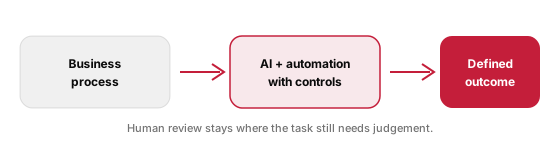
Start from the process you already run; add automation only where the steps and exceptions are clear.
Our Implementation Process
A clear sequence from discovery to a workflow you can operate and pause.
Discover
Task, systems and constraints.
Plan
Scope, controls and success checks.
Build
Workflow and integrations.
Test
Realistic and difficult cases.
Implement
Launch with named owners.
Improve
Monitor exceptions and adjust.
Examples of AI Automation
Illustrative use cases—not a claim that every engagement includes all of them.
Email & enquiry automation
Lead processing
Booking & scheduling
Data entry & extraction
Customer support triage
Document handling
Reporting drafts
Internal handoffs
What Progress Can Look Like
Directional outcomes for a well-scoped engagement—not guarantees of time, cost or headcount savings.
Less manual rework
Fewer copy-paste steps in the workflows you automate.
Clearer team focus
People handle exceptions and decisions, not every handoff.
More consistent handling
Agreed rules run the same way—when evaluation supports them.
Controlled operation
Permissions, logging and a path back to a person—not a savings guarantee.
Frequently Asked Questions
Straight answers about fit, controls, data and what cannot be promised.
What types of business tasks can be automated with AI?
Repetitive tasks with clear inputs and outputs are the usual starting point—enquiry triage, data extraction, routing and drafting. Tasks that need open-ended judgement stay human-led or use explicit approval steps.
Does every workflow need AI?
No. Rules-based automation or a process change may be more predictable and easier to maintain. Choose the approach after understanding the task.
Can AI act without human approval?
Only where the agreed use case, permissions and evaluation justify it. Consequential actions should have appropriate review and limits; autonomy is not the default objective.
What happens to confidential business information?
Data access, provider terms, storage, retention and permissions must be reviewed for the chosen setup. Do not send sensitive information into a prototype before those decisions are made.
Can you guarantee a percentage reduction in costs or time?
No. Any estimate needs a measured baseline, representative testing and a clear calculation method—this page does not promise savings.
Ready to Automate a Defined Business Process?
Tell us which task repeats, what systems it touches and where a person must stay in the loop. We can use that context to define a suitable next step.